A stroke changes things fast. One day everything works the way it always has, and the next, someone can't lift an arm properly, or their balance feels off, or a word won't come out right. It's disorienting, for the patient and for everyone around them.
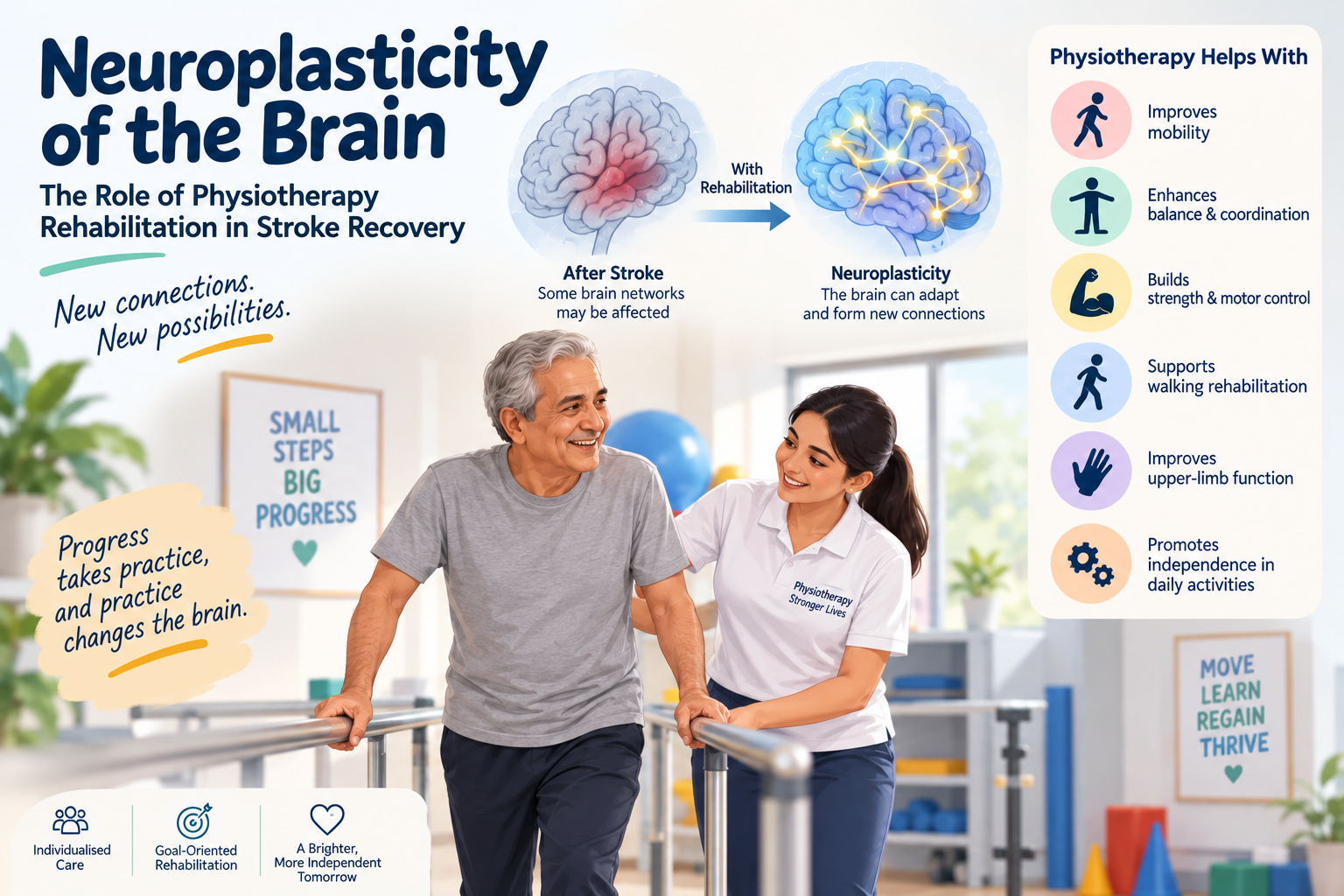
But there's something the brain does that gives recovery a real fighting chance: neuroplasticity. In plain terms, it's the brain's ability to rewire itself. When you practice a movement over and over, the brain strengthens the pathways involved in that movement, and in some cases builds new ones to work around damaged areas. This is what makes structured rehab so important after a stroke.
What's Actually Happening in the Brain
Your brain runs on networks of neurons talking to each other. A stroke damages part of that network, and depending on where the damage sits and how severe it is, you might see weakness on one side of the body, trouble walking, poor balance, or coordination problems.
Here's the part that gives people hope: the areas around the damaged region, along with other parts of the brain, can pick up some of that lost function. But this doesn't happen automatically just because time passes. It happens through repeated, guided practice. That's the whole point of physiotherapy after a stroke — it gives the brain structured opportunities to relearn.
Why Practice Has to Be the Right Kind of Practice
A lot of stroke rehab is about relearning things that used to be automatic. Sitting up without help. Standing. Moving from a bed to a chair. Walking again. Using an arm that doesn't quite listen anymore.
A few things make this kind of practice actually work:
- Doing it often. The nervous system needs repeated input to strengthen a pathway.
- Making it specific to the task. Practicing the actual activity (like reaching for a cup) tends to help more than doing generic exercises in isolation.
- Pushing enough, but not too much. There's a sweet spot of intensity that keeps the brain engaged without overwhelming the patient.
- Making it matter to the person. Someone is far more likely to stick with rehab if the activities connect to their real life, not just a checklist.
- Building up gradually. Exercises should get harder as the patient improves, not stay static.
- Showing up consistently. Rehab that happens sporadically doesn't give the brain the repeated exposure it needs.
No two strokes are the same, so no two rehab plans should look identical either.
What Physiotherapy Actually Looks Like in Practice
A physiotherapist starts by assessing strength, joint movement, balance, coordination, posture, walking, sensation, and where the patient is struggling day to day. From there, a plan gets built around a few areas.
In the first stages, this might be as basic as helping someone shift positions in bed or sit up safely. It looks small, but it's the foundation everything else builds on.
Sitting balance, standing balance, weight shifting, controlled reaching. All of it feeds into safer transfers and safer walking later on.
This usually starts with standing and weight transfer before progressing to actual steps, sometimes with support, gradually building distance and complexity. Some patients need a cane, walker, or brace along the way.
Weak muscles are common after a stroke, but strength alone doesn't bring back coordinated movement. So exercises often get built around real tasks like standing up from a chair or climbing a step, not just isolated muscle work.
This tends to be one of the harder areas to recover, and it usually involves a lot of repetitive reaching, grasping, and handling objects. For certain patients, more intensive approaches like constraint-induced therapy might come into the picture.
Instead of just doing exercises for the sake of exercises, therapy often folds in real activities, like getting dressed, reaching around the house, or walking around obstacles. This gives the brain meaningful information to work with, not just abstract movement.
Repetition Matters, But So Does Quality
More reps isn't automatically better if the movement itself is off. A physiotherapist watches for compensatory patterns (the body finding workarounds that aren't ideal long term) and adjusts the exercise so the practice is actually useful. How much practice makes sense depends on the severity of the stroke, fatigue levels, heart health, pain, balance, and other conditions the patient is managing.
Where Technology Fits In
Depending on the clinic and the patient's needs, rehab might include treadmills, virtual reality training, robotic-assisted devices, electrical stimulation, or biofeedback tools. These are add-ons though, not replacements for a physiotherapist's hands-on assessment and a plan built around the individual.
Practice at Home Counts Too
What happens in the clinic is only part of the picture. A good home exercise routine keeps the momentum going between sessions, and family members play a real role here too, whether that's making the home environment safer or just encouraging the person to stay engaged with their daily activities. Exercises should always follow what the physiotherapist has actually recommended, especially for patients with significant weakness or balance concerns.
It's Rarely Just Physiotherapy Alone
Stroke recovery usually pulls in more than one specialist. Neurologists, physiotherapists, occupational therapists, speech therapists, rehab physicians, psychologists, and dietitians often work together. Physiotherapy handles the physical side — movement, balance, mobility, independence — while the rest of the team covers communication, swallowing, cognition, and emotional wellbeing.
The Bigger Picture
The brain's ability to adapt after a stroke is real, but it doesn't happen passively. It takes repetition, task-specific practice, progressive challenge, and a rehab plan built around the person, not a generic template. Recovery looks different for everyone, and there's no single exercise that works for every patient.
If you or someone in your family has had a stroke, the right move is to talk to a neurologist and a physiotherapist and build a plan suited to that person's specific condition and stage of recovery.
Build a recovery plan suited to your condition
Our clinical team designs stroke rehabilitation programmes around your specific stage of recovery — not a generic template.
Book your assessment →Tags: Stroke Rehabilitation · Neuroplasticity · Neurological Physiotherapy · Stroke Recovery Exercises · Balance Training · Gait Rehabilitation · Motor Recovery · Neuro Physiotherapy